Home Service & Contractor Ops
You Don't Have a Lead Problem. You Have a Response-Time Problem.
A roofing company spent $4,000 a month on ads with a 4-hour response time. The traffic was fine. The window was gone. Speed is a system trait, not a team trait.
The roofing company that blamed traffic
A roofing company was spending $4,000 a month on Google Ads. Leads were coming in at a healthy clip. The close rate was low. The owner blamed traffic quality — figured the platform was sending junk leads.
When we mapped the actual follow-up flow, the average response time to a new inquiry was four hours and twenty minutes.
The traffic wasn't the problem. The window was gone before anyone called back.
What the data actually says
Studies on lead conversion consistently put the real window at five minutes. After that, the odds of reaching the prospect at all drop by more than 80%.
Home service and contracting businesses aren't usually losing leads because they lack volume. They're losing them in the twenty minutes after the inquiry lands — while the homeowner is still comparing options and still willing to talk. By the four-hour mark, they've typically already booked an estimate with someone else.
What a response layer actually looks like
The fix isn't a faster salesperson or another estimator. It's a response layer that fires the moment a form is submitted or a call is missed — not whenever someone gets back to their desk.
That layer does four things automatically:
- Instant acknowledgment — the homeowner knows their inquiry was received within 60 seconds
- Qualification question — one targeted question that moves the job forward (roof age, square footage, urgency)
- Booking link — a direct path to schedule an estimate without waiting for a callback
- Consistent timing — running at 9pm on a Friday exactly the same as 9am on a Tuesday, because roof leaks and burst pipes don't keep business hours
No one has to be at a desk. No one has to remember. The system responds every time, on every job type.
Speed is a system trait
Contractors who respond fast don't have faster estimators. They have better infrastructure.
The owner replying in four hours isn't lazy — they're running a process that requires a human at every step, and that human is usually on a roof or in a crawlspace. The competitor replying in four minutes isn't working harder — they built a system that doesn't wait for them to be free.
If you're spending real money to generate leads and losing them to slow follow-up, you don't have a marketing problem. You have a response-time problem — and response-time problems are solvable with automation, not headcount.
Next steps
Pull your ad spend and your actual response times side by side for the last month. Most owners are shocked by the gap once they see it in one place.
Bring your last ten quotes — won and lost — and a normal week off the schedule. In about 45 minutes, we can usually show you exactly where the capacity, and the booked jobs, are getting eaten.
Keep reading
Guide
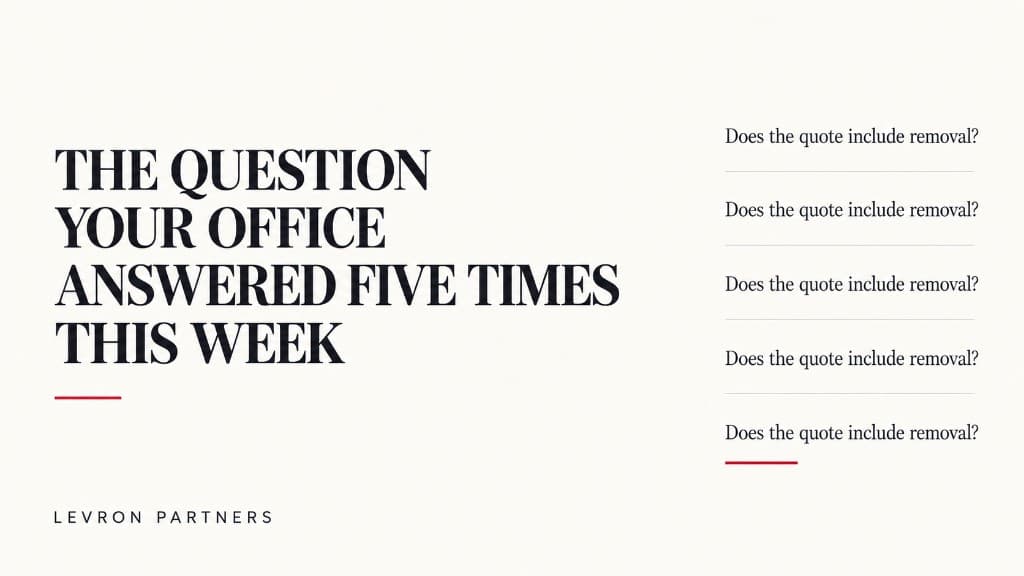
The Question Your Office Answered Five Times This Week
A homeowner calls about an install quote. Then another texts about the warranty. Someone else wants to know what happens after the inspection. Your team knows the answer. It may live in the estimator’s head, an old text thread, or the office manager’s memory — so someone stops, checks the details, and types it again.

Guide
The AI Slowdown Debate — and What It Means for Your Business
Washington turned down requests from AI leaders to slow down. Markets fell, and paying customers filed lawsuits. Plus an AI that speaks 97 languages.
Guide
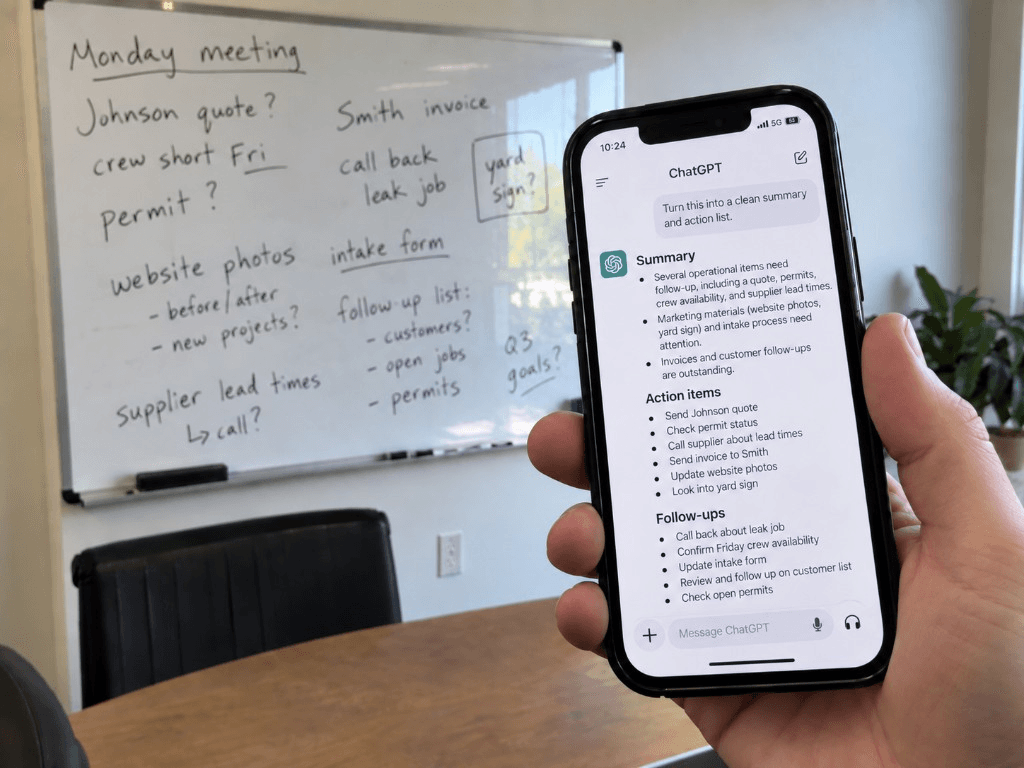
Stop Retyping Things That Are Already on Paper
Every AI app has a camera button. Most people have never pressed it. Here's what it actually does — and where it's genuinely useful for a trade or service business.
Let’s find the hours.
Bring your last ten quotes and a normal week off the schedule. Forty-five minutes is usually enough to see where it’s going.